Weaving Threaded Narratives: Sequencing Dialogue Branches to Unlock Alternate Endings in Choice-Driven Adventures
Written by Elena Otto · May 19, 2026
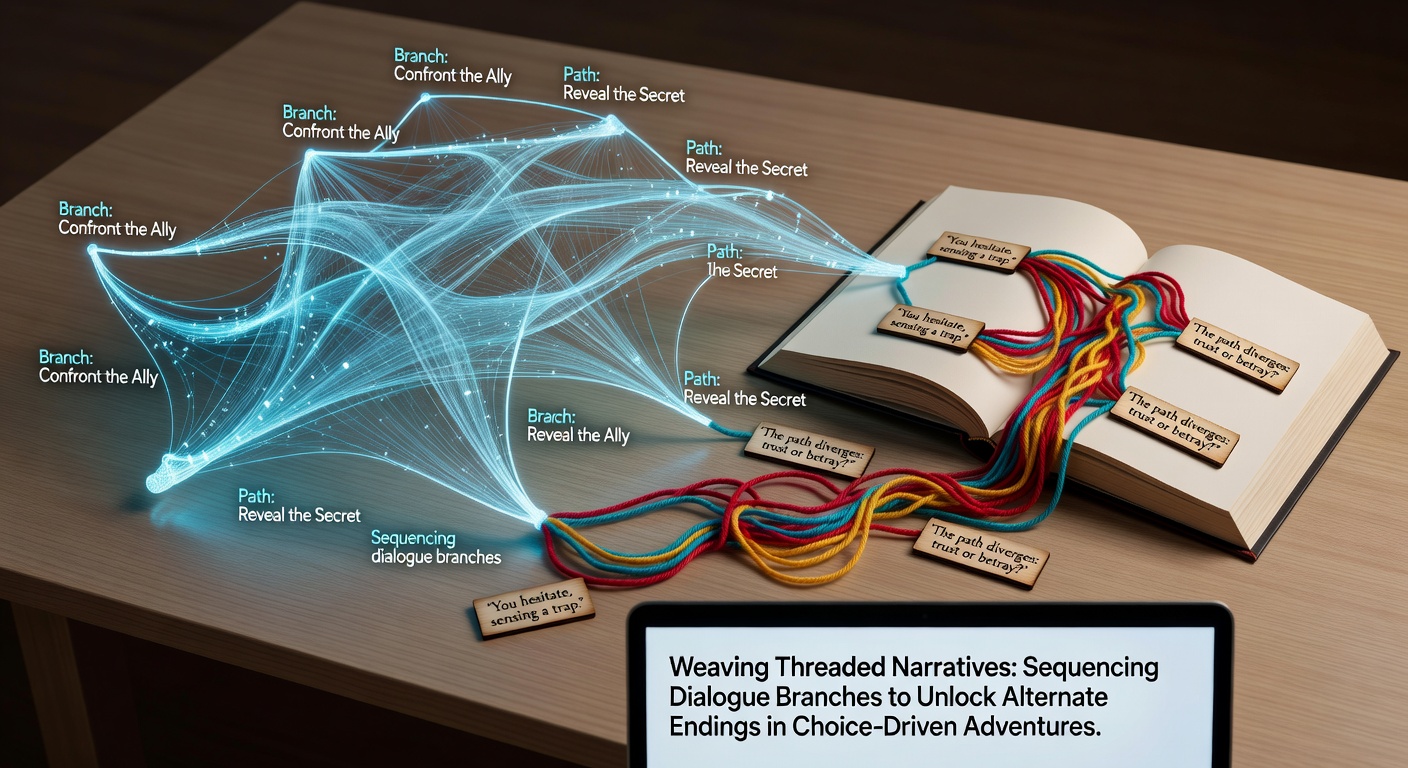
Weaving Threaded Narratives: Sequencing Dialogue Branches to Unlock Alternate Endings in Choice-Driven Adventures
Choice-driven adventures rely on carefully sequenced dialogue branches that respond to player decisions and guide stories toward distinct conclusions, and developers build these systems by mapping conversations as interconnected nodes where each selection alters available options and future outcomes. Game designers establish core threads early in development, then layer conditional checks that track prior choices and determine which branches remain accessible later.
Core Mechanics of Dialogue Sequencing
Developers organize dialogue into tree structures that expand or contract based on accumulated variables, and these variables record everything from character relationships to key revelations so the system can reference them during later scenes. A single conversation might offer three responses that each unlock separate follow-up lines while closing off others, which creates natural divergence without requiring entirely separate scripts for every possibility. Observers note that efficient sequencing reuses shared segments across multiple paths, and this reuse keeps file sizes manageable while preserving narrative consistency across playthroughs.
Conditional flags sit at the heart of alternate endings because they evaluate the cumulative weight of decisions rather than isolated moments, and when a player reaches a pivotal scene the engine checks the current state of several flags to select the appropriate concluding sequence. Titles released ahead of May 2026 already demonstrate refined versions of this approach, with some incorporating time-sensitive branches that expire after certain events occur.
Building Layered Branch Networks
Design teams begin by outlining major story beats and the endings tied to them, then work backward to insert the dialogue choices that steer players toward those conclusions. Each branch receives weighted importance so that minor decisions accumulate into meaningful shifts while major ones produce immediate divergence, and this weighting prevents every small selection from overwhelming the system. Researchers at institutions focused on interactive media have documented how balanced weighting improves player retention because users perceive greater agency without encountering contradictory story states.

One effective technique involves hub conversations that reset after key events yet retain memory of earlier exchanges, which lets characters reference past interactions without locking players into single routes. Developers test these hubs extensively to verify that no combination of choices creates dead ends or loops that contradict established lore, and automated tools now scan for unreachable branches during quality assurance cycles.
Technical Implementation and Testing
Modern engines handle dialogue sequencing through visual scripting interfaces that display nodes and connections, allowing writers to adjust paths without deep programming knowledge while programmers add custom conditions for complex state tracking. Data from industry reports indicate that projects using these visual tools complete narrative implementation phases 20 to 30 percent faster than those relying solely on code-based systems. Testing protocols include multiple playthroughs with deliberately varied choice patterns to confirm every ending remains reachable and that no unintended overlaps occur between conclusion sequences.
Sound design teams synchronize voice lines and music cues with branch outcomes, ensuring tonal consistency even when players arrive via different routes, and localization teams adapt these elements for regional releases while preserving the logical flow of conditional dialogue.
Player Experience and Narrative Impact
Players who explore multiple runs discover how early dialogue selections ripple forward to reshape later events, and this discovery encourages replay because each ending reveals new information about characters and world lore. Studies conducted by academic groups in North America and Europe show that games featuring well-sequenced branches achieve higher completion rates for secondary playthroughs compared with linear titles. Community forums often catalog the precise flag combinations required for rare endings, turning the process of uncovering hidden paths into a shared activity.
Designers incorporate feedback from early access periods to refine branch visibility so that players receive enough cues to understand when a choice matters without receiving explicit spoilers, and this balance maintains immersion while guiding users toward satisfying conclusions.
Conclusion
Sequencing dialogue branches remains a foundational practice in choice-driven adventures because it transforms static scripts into dynamic narratives that reward exploration and repeated engagement, and ongoing refinements in tools and testing continue to expand what these systems can achieve within single play sessions or across multiple runs.