Decay Orbit Planning: Calculating Gravitational Assists for Multi-Body Rendezvous in Realistic Spaceflight Games
Written by Eden Krüger · Jun 23, 2026
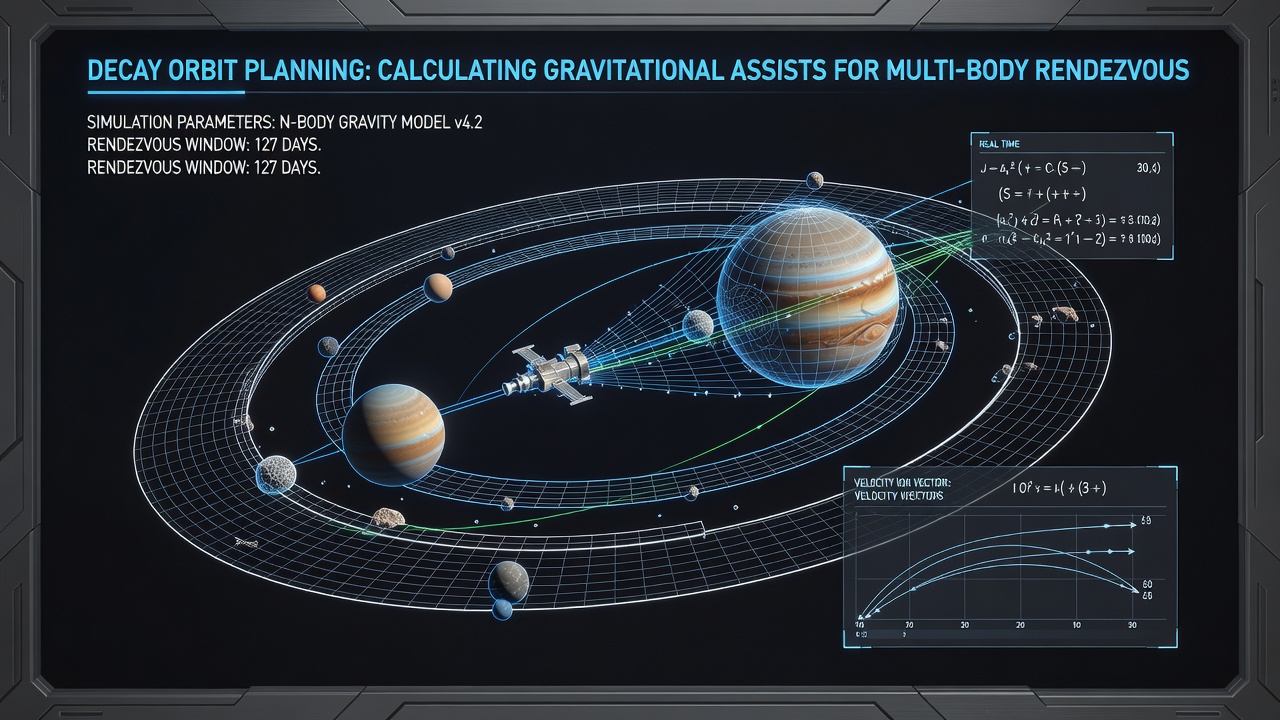
Decay Orbit Planning: Calculating Gravitational Assists for Multi-Body Rendezvous in Realistic Spaceflight Games
Realistic spaceflight games simulate orbital mechanics where decay orbit planning requires precise calculations for gravitational assists during multi-body rendezvous, and developers build these systems on Newtonian physics models that mirror real aerospace principles. Players engage with tools that plot trajectories across multiple celestial bodies while accounting for fuel constraints and timing windows that shift based on relative velocities.
Fundamentals of Orbital Decay in Simulated Environments
Orbital decay occurs when atmospheric drag or gravitational perturbations reduce altitude over successive passes, and games replicate this through integrated equations that update position data each frame. Engineers who design these mechanics incorporate patched conic approximations to handle transitions between spheres of influence, allowing simulations to maintain accuracy without excessive computational load. Data from sources like NASA orbital studies informs how developers calibrate decay rates so that missions unfold with realistic timelines rather than instantaneous jumps.
Calculation begins with vector analysis of current velocity relative to the primary body, then layers in perturbations from secondary masses that create the conditions for assists. Those who study these systems note that successful planning hinges on identifying swing-by opportunities where a spacecraft gains or sheds speed by passing through a planet's gravity well at the correct angle and distance.
Gravitational Assist Mechanics and Trajectory Mapping
Gravitational assists function by exchanging momentum during close encounters, and games implement this through conservation of energy equations that adjust the spacecraft's hyperbolic excess velocity upon exit. Observers note that multi-body rendezvous adds complexity because the player must synchronize arrival at one body with departure windows toward the next, often chaining assists across several planets to reach distant targets. Research indicates that effective planning software in these titles uses numerical integrators to solve the n-body problem in segments, breaking the journey into manageable patched trajectories that players can refine iteratively.
Turns out the process demands repeated adjustment of periapsis altitude and argument of periapsis to optimize the deflection angle, which directly affects the resulting velocity vector. One study from the European Space Agency archives demonstrates how small changes in approach geometry produce large differences in post-assist speed, a principle that game developers translate into interactive planning interfaces with sliders and predictive overlays.
Multi-Body Rendezvous Techniques in Game Simulations
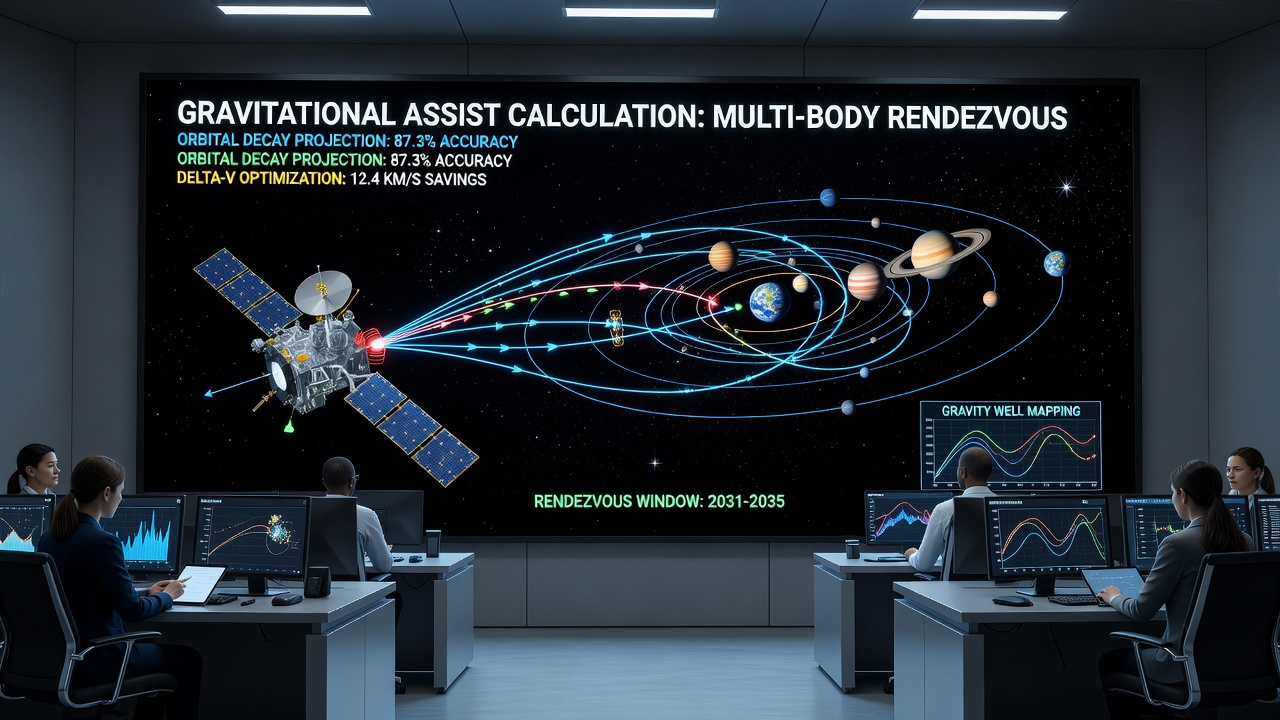
Multi-body rendezvous extends single-target docking into sequenced encounters where timing between gravitational assists determines overall mission viability, and games provide ephemeris data that updates according to simulated celestial calendars. Players calculate launch dates by solving Lambert's problem for each leg while inserting constraints for assist altitudes that avoid atmospheric capture or excessive radiation exposure. Figures from academic papers on astrodynamics reveal that iterative solvers converge faster when initial guesses incorporate known real-world mission profiles such as Voyager or Cassini trajectories.
And yet the added layer of orbital decay means planners must also forecast how long each coasting phase will last before drag begins to pull the craft out of the optimal assist corridor. This requires cross-referencing current orbital elements against predicted positions of the next target body, often visualized through porkchop plots that display delta-v costs across departure and arrival dates. In June 2026 several simulation titles received patches that improved the fidelity of these plots by incorporating higher-order gravity harmonics drawn from recent planetary probe telemetry.
Practical Calculation Workflows and Tools
Effective workflows start with coarse trajectory sketches using conic sections, then refine them through forward propagation that includes third-body effects and non-spherical gravity. Researchers who model these games find that Monte Carlo sampling helps players evaluate risk across families of similar trajectories when small errors in assist execution could cascade into missed rendezvous windows. Industry reports from organizations such as the European Space Agency supply reference datasets that developers integrate to ensure assist outcomes align with documented mission results.
Game interfaces commonly expose editable parameters for ejection velocity, inclination, and argument of periapsis, letting users watch how each variable shifts the final arrival conditions at the target body. Those who practice these calculations repeatedly discover that combining multiple assists in a single tour reduces total propellant mass far below direct-transfer requirements, a fact confirmed by both historical missions and in-game telemetry logs.
Conclusion
Decay orbit planning combined with gravitational assist calculations forms a core skill set in realistic spaceflight simulations, where success depends on accurate modeling of multi-body dynamics and careful timing. Developers continue to refine these systems using data from actual space agencies, ensuring that players encounter the same constraints and opportunities that real mission designers face. As simulation fidelity increases, the gap between game-based practice and professional astrodynamics narrows further, providing accessible training environments grounded in established physics.